Health Insurance Claims Management Software: 7 Features to Look For in 2026
Health insurance claims management software can make a big difference to how efficiently a healthcare practice handles billing, rejected claims and payments. But with so many systems offering similar features, how do you know what actually matters?
A medical claim might begin with something as simple as a patient consultation. From there, however, things can become complicated quickly.
Patient information needs to be accurate. Clinical and billing information needs to be captured correctly. The claim needs to be submitted through the appropriate channel, and someone needs to monitor what happens afterwards.
Was it accepted? Rejected? Returned? Paid correctly?
Then there is reconciliation.
If these tasks are being handled manually across several different systems, the administrative workload can become surprisingly heavy.
This is where health insurance claims management software can help.
The right platform can connect much of the claims journey, helping practices submit claims, identify problems, monitor outcomes and keep track of payments without turning every rejected claim into a miniature investigation.
What Is Health Insurance Claims Management Software?
Health insurance claims management software helps healthcare providers manage claims from the point where patient and billing information is captured through to submission, processing and payment.
The exact features differ between platforms, but a good solution may include:
- Patient and membership verification
- Medical billing and invoicing
- ICD-10 and procedure coding
- Electronic claim submission
- Claim status tracking
- Rejection management
- Reversal management
- Remittance reconciliation
- Patient co-payments
- Cash billing
- Financial reporting
In other words, the software isn’t simply about sending a claim.
It’s about managing what happens before, during and after the claim is submitted.
For practices operating in New Zealand, the specific workflow may involve different payer and claiming processes depending on the type of service being provided. For example, ACC supports electronic claiming through practice management systems and ProviderHub, making the ability to integrate claims activity into the wider practice workflow particularly relevant.
The broader principle remains the same: the easier it is to see and manage the entire claims lifecycle, the less administrative friction your team faces.
Why Claims Management Matters to Your Practice
Think about how many small administrative tasks can sit behind one successfully processed claim.
Someone has to capture the patient’s information.
The consultation needs to be documented.
The correct clinical and billing information needs to be recorded.
An invoice or claim needs to be created.
The claim needs to be submitted.
Then somebody needs to monitor the response.
If it is rejected, someone has to determine why, correct the problem and decide what needs to happen next.
That’s where inefficient systems can become expensive.
Not necessarily because the software itself costs more, but because staff time has a cost too.
A connected workflow can look something like this:
Accurate patient information → clinical information → billing → claim submission → claim response → correction → payment → reconciliation
The more of that journey your software can help manage, the easier it becomes to see what is happening.
And visibility matters.
A claim that has been accepted needs different attention from one that has been rejected. A paid claim needs different treatment from one that is still outstanding.
Your team shouldn’t have to guess.
7 Features to Look for in Health Insurance Claims Management Software
1. Fast or Real-Time Claims Submission
Start here.
One of the most useful capabilities to look for is fast, preferably real-time, claims submission and response handling where the relevant payer or claiming channel supports it.
In a batch-based process, claims may be collected and submitted together. The practice then waits for responses to come back.
A problem discovered immediately is usually easier to deal with than the same problem discovered several days later.
For example, imagine a claim contains incorrect patient or membership information.
If the system provides a quick response, the practice can identify the issue while the relevant information is still fresh, correct it and take the appropriate next step.
With a delayed response, that same claim may simply appear on a follow-up list days later.
Fast processing can therefore provide better visibility into whether a claim has been:
- Accepted
- Rejected
- Returned or requiring attention
- Paid
- Still outstanding
For ACC-related workflows, practices can use a PMS or ProviderHub to lodge claims and check claim information, with ACC specifically noting that using a PMS can provide an efficient way to manage these tasks.
And that is the real value.
Faster claims processing isn’t simply about doing something quicker. It’s about finding problems sooner.
2. Accurate ICD-10 and Procedure Coding
Coding sits right in the middle of the claims process.
If clinical or billing information is incomplete or incorrect, the claim may encounter problems before it ever reaches the payment stage.
Your software should therefore support the coding requirements relevant to your practice, including ICD-10 and applicable procedure codes.
Ideally, coding shouldn’t involve copying the same information from one system into another.
That’s where integrated workflows can help.
Information captured during the consultation can potentially flow into billing and invoicing, reducing unnecessary manual re-entry.
When comparing platforms, look for:
- ICD-10 support
- Procedure-code functionality
- Tariff or fee support where relevant
- Coding validation
- Reduced duplicate data entry
- Links between clinical and billing information
It sounds simple.
But reducing one unnecessary piece of manual data entry can make a difference when that task happens hundreds of times a month.
3. Patient and Payer Information Verification
A claim can fail because of something that seems incredibly small.
A patient identifier.
Incorrect information.
An outdated detail.
A mismatch between information held by the practice and the relevant payer or claiming system.
That’s why patient and payer information verification should be part of the conversation when evaluating claims-management software.
The earlier incorrect information can be identified, the better.
Depending on the system and claiming environment, verification capabilities may include:
- Patient details
- Membership information where applicable
- Patient demographics
- Payer information
- Claim-related eligibility or benefit information
- Validation of required claim fields
The objective isn’t to create more administration.
It’s the opposite.
Good claims management should prevent avoidable administration wherever possible.
If your team only discovers an information problem after a claim has been rejected, they’ve already spent time processing something that could potentially have been corrected earlier.
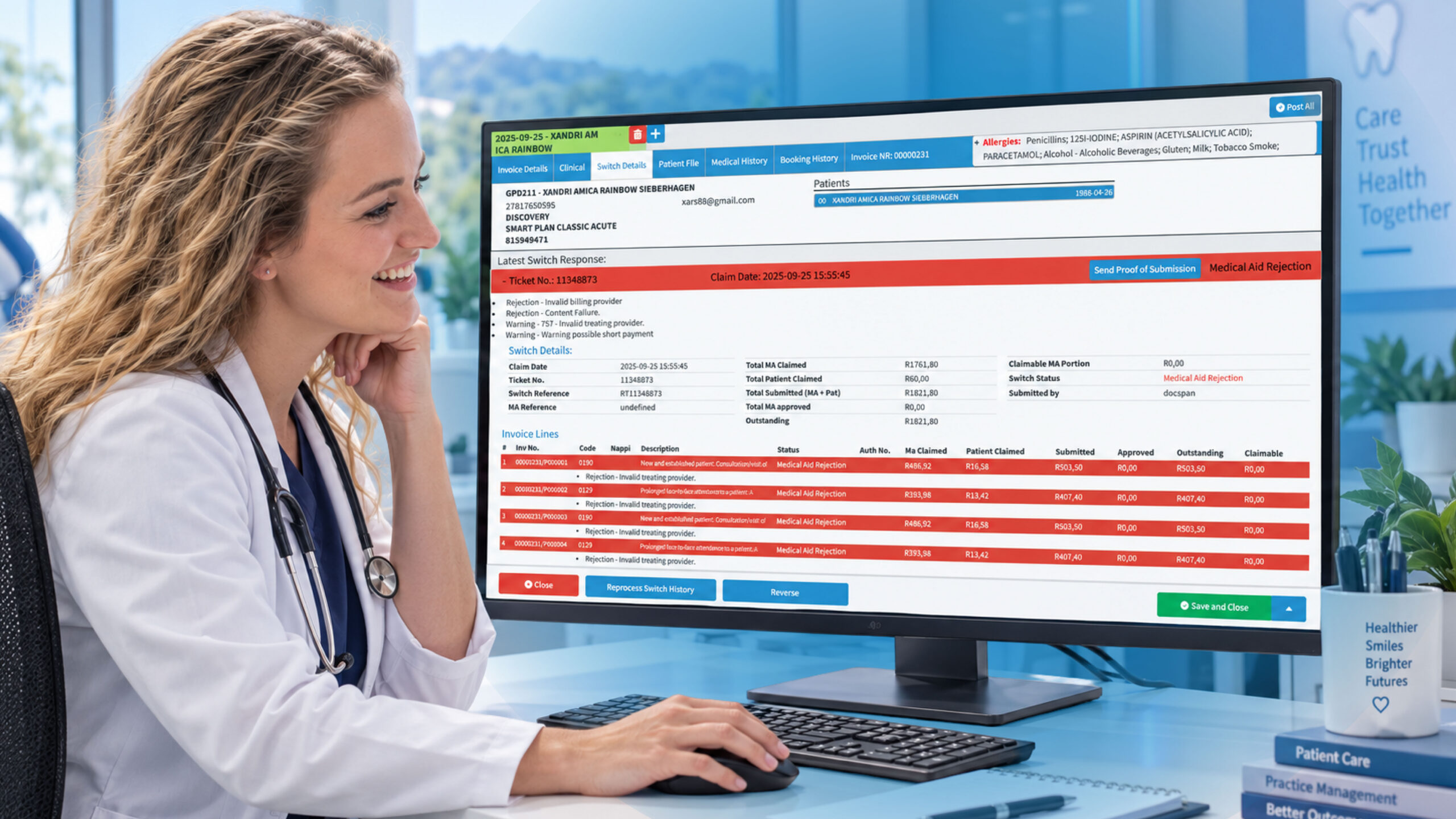
4. Rejection and Claim-Exception Management
Rejected claims are a reality of healthcare billing.
The important question isn’t whether your practice will ever encounter one.
It’s what happens when you do.
Without a proper system, rejected claims can become a messy collection of spreadsheets, emails, notes and reminders.
A good platform should make claim outcomes easy to see.
Look for clear visibility of:
- Rejected claims
- Reasons for rejection
- Accepted claims
- Claims requiring attention
- Resubmitted claims
- Outstanding claims
This changes the conversation from:
“I wonder what happened to that claim?”
to:
“The system says there’s a problem. Let’s fix it.”
That’s a much better place for a practice to be.
5. Remittance Reconciliation
Submitting a claim is not the finish line.
Getting paid is.
And even when money arrives, your work may not be finished. The practice still needs to know whether the payment matches what was originally billed.
That’s where remittance reconciliation becomes important.
A useful system should help connect the payment received with the claim or invoice that generated it.
Ideally, practices should be able to examine information clearly and identify things such as:
- Paid claims
- Unpaid claims
- Short payments
- Rejected services
- Outstanding balances
- Patient amounts still due
- Payment discrepancies
Without good reconciliation, staff can spend considerable time trying to match payments manually.
The software should make that process clearer, not add another layer of confusion.
For practices using ACC digital services, ACC says PMS and ProviderHub workflows can provide access to invoice information, including submission status, service-item status and payment advice.
That kind of visibility is exactly what claims-management software should aim to provide.
6. Integrated Patient and Cash Billing
Medical practices don’t necessarily deal with one type of payment.
You might have an electronically submitted claim in the morning, a patient payment later, and another type of account activity in the afternoon.
Your software needs to cope with the reality of the practice.
Look for support for:
- Electronic claiming
- Patient payments
- Cash billing where applicable
- Invoices
- Patient accounts
- Outstanding balances
- Payment tracking
Integration is particularly useful here.
When billing information, patient records and claims are connected, staff don’t have to keep jumping between systems to understand what’s happening.
Less switching. Less duplicate entry. Fewer opportunities for something to fall through the cracks.
7. Secure Health Information Management
There’s another part of claims software that shouldn’t be overlooked:
patient-data protection.
Claims systems can handle sensitive health and financial information. Practices therefore need to understand how a software provider protects, stores and controls access to that information.
Don’t simply ask whether a provider is “secure.”
Ask practical questions.
- Where is patient information stored?
- Who can access it?
- How are user permissions controlled?
- Can access be audited?
- What happens when a staff member leaves?
- How is information backed up?
- How is data protected during transmission?
- What security controls does the provider have in place?
For New Zealand practices, privacy obligations around health information make these questions particularly important.
The point isn’t to create a complicated security checklist for the sake of it.
It’s to understand how your practice’s information is being handled in the real world.
Claims management isn’t only about financial administration.
It’s also about handling someone’s private health information responsibly.
How Claims Software Can Affect Cash Flow
Here’s where claims management becomes more than an administrative issue.
It can affect cash flow and financial visibility.
Suppose a practice submits a claim and it contains an error.
If that error is discovered quickly, the practice has an opportunity to correct it and take the appropriate next step.
If it isn’t discovered until much later, the claim may already have moved beyond the point where your team expected it to be resolved.
The practice then waits.
Now multiply that by dozens of claims.
Then hundreds.
Suddenly, something that looked like a small administrative delay can become a bigger financial-management problem.
That’s why the goal shouldn’t simply be to submit more claims.
The goal should be to create a process where claims are:
Submitted accurately → monitored → corrected when necessary → paid → reconciled
That’s the full lifecycle.
And visibility across that lifecycle can make it much easier for practice managers to understand where money is sitting and where administrative problems are occurring.
Questions to Ask Before Buying Claims Management Software
A software demonstration should be more than someone clicking through a beautiful dashboard.
Ask to see the actual claims workflow.
Here are ten questions worth taking into the demo:
- Does the platform support electronic or real-time claims submission where applicable?
- How quickly do claim responses appear?
- Can I clearly see accepted, rejected and outstanding claims?
- How are rejected claims handled?
- Can corrected claims be resubmitted easily?
- How are ICD-10 and procedure codes handled?
- How are fees, tariffs or claim rules maintained?
- Can relevant patient or payer information be verified?
- Can payments and remittances be reconciled against invoices or claims?
- Where is patient information stored and how is it protected?
Don’t be afraid to ask the vendor to show you an actual example.
“Show me a rejected claim.”
What happens next?
That one demonstration can tell you far more than a page of feature descriptions.
Don’t Choose Software Based on Price Alone
Price matters.
Obviously.
But the cheapest software isn’t necessarily the least expensive solution for your practice.
Different providers may use different pricing structures, including:
- Per claim
- Per practitioner
- Per practice
- Monthly subscription
- Custom quotations
A smaller practice might prefer predictable pricing.
A higher-volume practice may evaluate the cost per claim or transaction more closely.
But there’s another calculation that often gets missed.
What does the entire software stack cost?
If you pay for one system for claims, another for clinical notes, another for appointment management and additional services for communication or administration, the costs can start adding up.
A slightly more expensive integrated platform may actually offer better value if it removes several separate subscriptions and reduces manual work.
So don’t compare the monthly price alone.
Compare what you’re actually getting.
Where AI Fits Into Claims Management
AI is becoming a bigger part of healthcare software, and it can have a role in reducing administrative workload.
Depending on the platform, AI and automation may assist with areas such as:
- Clinical documentation
- Patient intake
- Appointment administration
- Invoice creation
- Coding assistance
- Administrative workflows
That can be useful.
But there’s an important distinction.
AI should improve a strong claims process, not distract from a weak one.
Fast submission, accurate coding, effective validation, rejection management and reconciliation still matter.
An impressive AI assistant doesn’t help much if the practice still has to manually chase outstanding claims at the end of every month.
Start with the fundamentals.
Then look at automation.
How to Choose the Right Software for Your Practice
Before comparing providers, identify your biggest sources of administrative frustration.
Not broad problems.
Specific ones.
For example:
- “Our team spends hours dealing with rejected claims.”
- “We don’t know which claims are still outstanding.”
- “Remittance reconciliation takes too long.”
- “Doctors or staff enter billing information more than once.”
- “Patient information isn’t consistently checked.”
- “Our billing and clinical systems don’t communicate.”
- “We spend too much time moving information between systems.”
Once you’ve identified the problems, use them to evaluate every platform.
A system doesn’t need to have every feature imaginable.
It needs to solve your problems.
That distinction can save a practice a lot of money, and a lot of headaches.
What to Look for in Your Next Claims Platform
The best health insurance claims management software isn’t necessarily the platform with the longest feature list.
It’s the one that makes the claims lifecycle easier to manage.
Look for efficient submission, accurate coding, information validation, rejection management and effective reconciliation. Make sure the billing workflow fits the way your practice actually operates, and don’t overlook patient-data protection.
For practices using ACC-related workflows, it is also worth checking exactly how the software connects with supported ACC claiming processes. ACC notes that ProviderHub supports invoicing and claims, while practices should continue using their PMS where it supports ACC services.
Most importantly, think beyond the initial claim.
A successful claims process should look something like this:
Capture accurate information → create the bill → submit the claim → receive the response → fix problems → receive payment → reconcile the payment.
When software can support that journey without creating unnecessary manual work, your team gets something valuable back.
Time.
And in a busy healthcare practice, that might be one of the most useful features of all.
Could GoodX Help?
GoodX is designed to bring important practice-management and administrative workflows together, helping healthcare practices spend less time dealing with disconnected processes and more time focusing on patients.
If you’re evaluating your next practice-management or claims solution, take the time to look beyond the feature list.
Look at the whole workflow.
Disclaimer: This article is provided for general informational and educational purposes only. While GoodX Software takes reasonable care to ensure that the information is accurate and current at the time of publication, laws, regulations, industry standards, healthcare policies and technology may change. The content should not be regarded as medical, legal, financial or other professional advice. Readers should verify information relevant to their circumstances and consult an appropriately qualified professional where necessary. GoodX Software accepts no responsibility for decisions made or actions taken solely on the basis of this content.